

Last Updated on September 17, 2025 by courtnews reporter
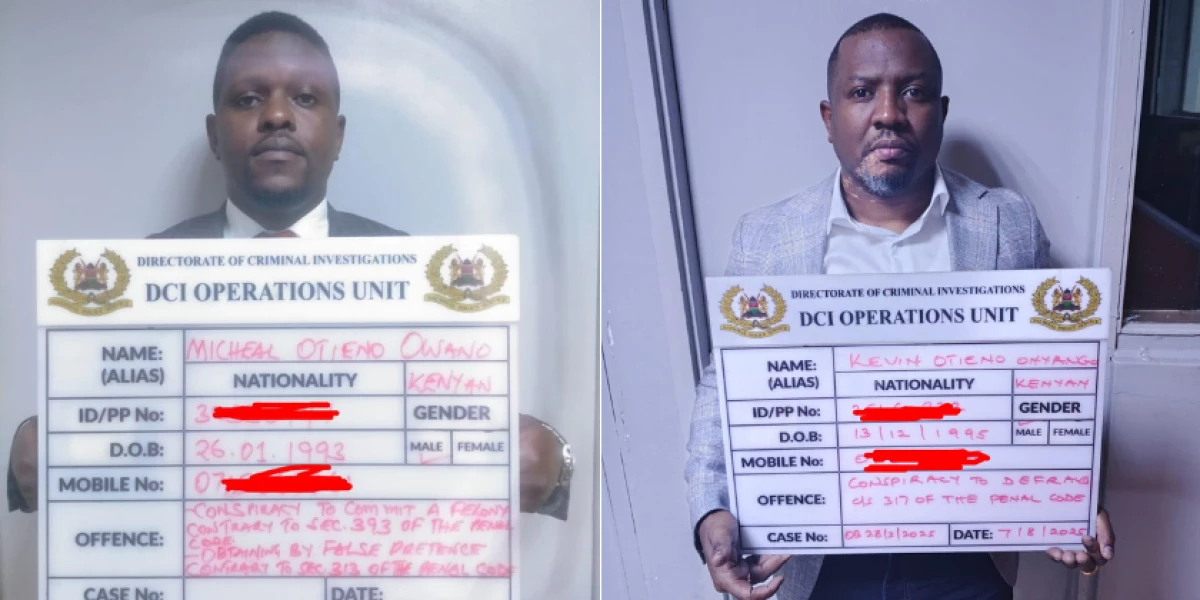
Michael Otieno Owano fraud case
Kenya’s multi-billion-shilling gold fraud industry is once again under the spotlight after detectives from the Directorate of Criminal Investigations (DCI) arrested Nairobi-based lawyer Michael Otieno Owano in connection with a Ksh.79.9 million scam targeting a Canadian investor.
Owano, the proprietor of Otieno M.O. Law Advocates, is accused of using his law firm’s accounts to receive funds wired by unsuspecting investors in what appeared to be a legitimate gold export transaction. His arrest underscores how criminal syndicates often exploit professionals and legal structures to create the illusion of legitimacy in fraudulent dealings.
How the Ksh.79M Gold Scam Unfolded
According to the DCI, the complainant — a Canadian businessman — was lured into an elaborate deal involving the export of 250 kilograms of gold allegedly destined for Dubai aboard a private jet.
-
On April 15, 2025, a Proforma Invoice of USD 318,400 (about Ksh.42.4 million) was issued under the name of EAI Logistics. The victim wired the funds directly into Owano’s law firm account.
-
Shortly after, the victim was instructed to make a further payment of USDT 300,000 (about Ksh.37.5 million) into a cryptocurrency wallet, also controlled by the syndicate.
-
The total amount lost was USD 618,000 (Ksh.79.9 million). No gold was ever delivered, and the documents provided — including title and export certificates — turned out to be fake.
The scheme was carefully designed to mimic real gold export procedures, with forged documents, company seals, and false assurances. By channeling payments through a lawyer’s client account, the syndicate managed to build trust with the foreign investor.
Other Suspects and Ongoing Crackdown
Owano’s arrest is the latest in a series of high-profile crackdowns by the DCI against gold fraud cartels operating in Nairobi.
-
Francis Talla Ouafo alias “Allain”, a Cameroonian national believed to be the mastermind, was earlier arrested and arraigned at the Milimani Chief Magistrate’s Court on July 31, 2025.
-
Lupemba Lorenzi Olivier, a Congolese national, is facing charges in another gold scam targeting a Gabonese investor. The court granted detectives seven days to hold him while investigations continue, with the case set for mention on August 13, 2025.
-
Kelvin Otieno Onyango alias “Kevo Sonko”, identified as the director of SwiftTaxis Logistics Ltd, was also arrested. He allegedly hosted the complainant in his Nairobi office, where the fraudulent transaction was negotiated. The investor later transferred USD 140,000 (Ksh.18 million) into an escrow account managed by the syndicate.
According to the DCI, all suspects are currently in custody, and prosecutors are preparing to bring multiple charges, including obtaining money by false pretenses, conspiracy to defraud, and money laundering.
Why Gold Fraud is Rampant in Kenya
Kenya has become notorious for fake gold scams, which often target foreign investors from Asia, Europe, and North America. Several factors have made the country attractive for such schemes:
-
Proximity to gold-producing countries such as the Democratic Republic of Congo, Tanzania, and South Sudan, making Nairobi a key transit hub for genuine mineral exports.
-
Weak due diligence by investors, many of whom rely on introductions by middlemen instead of engaging licensed dealers.
-
Exploitation of professional networks — including lawyers, bankers, and brokers — who provide credibility to fraudulent deals.
-
Corruption and document forgery, which allow syndicates to produce seemingly genuine export permits, customs clearance papers, and even certificates of origin.
The DCI has repeatedly warned investors to only transact with licensed dealers listed by the Ministry of Mining and to avoid “too-good-to-be-true” deals involving private jet shipments or secretive transfers.
The Bigger Picture: Impact on Kenya’s Reputation
While Kenya is not among the world’s top gold producers, the country has become a magnet for international scams linked to the gold trade. The proliferation of such fraud has had several consequences:
-
Damaged investor confidence in Nairobi as a regional business hub.
-
Increased scrutiny by foreign governments, with warnings issued to their nationals about fraudulent gold dealers in Kenya.
-
Reputational damage to the legal profession, especially when lawyers’ trust accounts are misused for money laundering.
The arrest of lawyer Owano is seen as a critical step in holding enablers accountable and deterring other professionals from facilitating criminal networks.
What Happens Next
The DCI has confirmed that investigations are ongoing and that the suspects will be arraigned on multiple counts once files are submitted to the Office of the Director of Public Prosecutions (ODPP).
Meanwhile, international cooperation is expected, as the complainant in this case is a Canadian national, meaning the matter could draw the attention of Interpol and Canadian authorities.
If convicted, the accused persons face lengthy prison terms under Kenya’s Penal Code, including up to 10 years for conspiracy to defraud and harsher penalties under the Proceeds of Crime and Anti-Money Laundering Act (POCAMLA).
Conclusion
The arrest of Nairobi lawyer Michael Otieno Owano in the Ksh.79 million gold scam highlights how fraudulent cartels exploit professional networks to con foreign investors. With several suspects already in custody — including Cameroonian and Congolese nationals — the DCI appears determined to dismantle the syndicates tarnishing Kenya’s global image.
But as past cases have shown, unless there are swift prosecutions and convictions, gold scams are likely to continue thriving, fueled by international greed and local corruption.
Kenya Court News Today – Live High Court & DPP Updates click here 👉 /kenya-court-news-today