
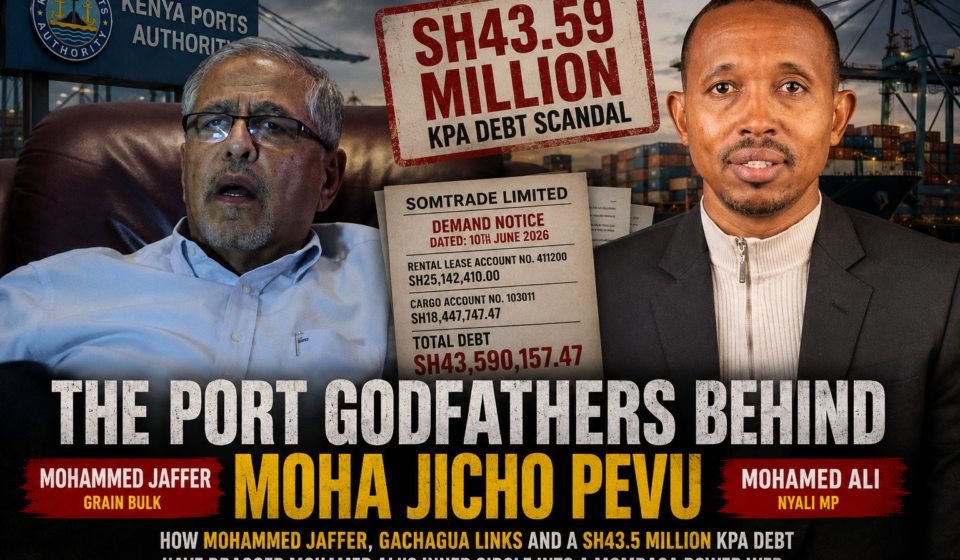
THE PORT GODFATHERS BEHIND MOHA JICHO PEVU: How Mohammed Jaffer, Gachagua Links and a Sh43.5 Million KPA Debt Pulled Mohamed Ali’s Inner Circle Into a Mombasa Storm

Last Updated on June 25, 2026 by Joao Pedro
Nyali MP Mohamed Ali has spent years building a political brand around outrage. He has made a career out of calling out corruption, blasting state excess and presenting himself as the loud outsider willing to expose the rot that others fear touching. That image has worked for him because it is simple and powerful. He is the fighter. He is the truth teller. He is the man who says what others are too compromised to say.
But the problem with that kind of brand is that it collapses very quickly when the spotlight swings back home.
That is where Mohamed Ali now finds himself. A debt file linked to the Kenya Ports Authority, a company tied to people in his immediate political orbit, and fresh claims about campaign financiers from the cargo and grain trade are combining into a story that is far bigger than a routine commercial dispute. It is becoming a story about power, access, protection and the business interests sitting behind a politician who has long sold himself as an enemy of dirty systems.
At the centre of the storm is Somtrade Limited, a company that documents now place on KPA’s debt radar over Sh43,590,157.47 in alleged rental and cargo arrears. On paper, Mohamed Ali’s name does not appear in the material as a shareholder. But the names that do appear make the story politically explosive. Among them is Naeem Shafiq Mohamed, widely known in Mombasa political circles as Mohamed Ali’s close aide, confidant and political right-hand man. Also appearing in the company records is Mohamed Ibrahim Abdi, the former Mombasa County Executive Committee Member for Trade during Hassan Joho’s administration.
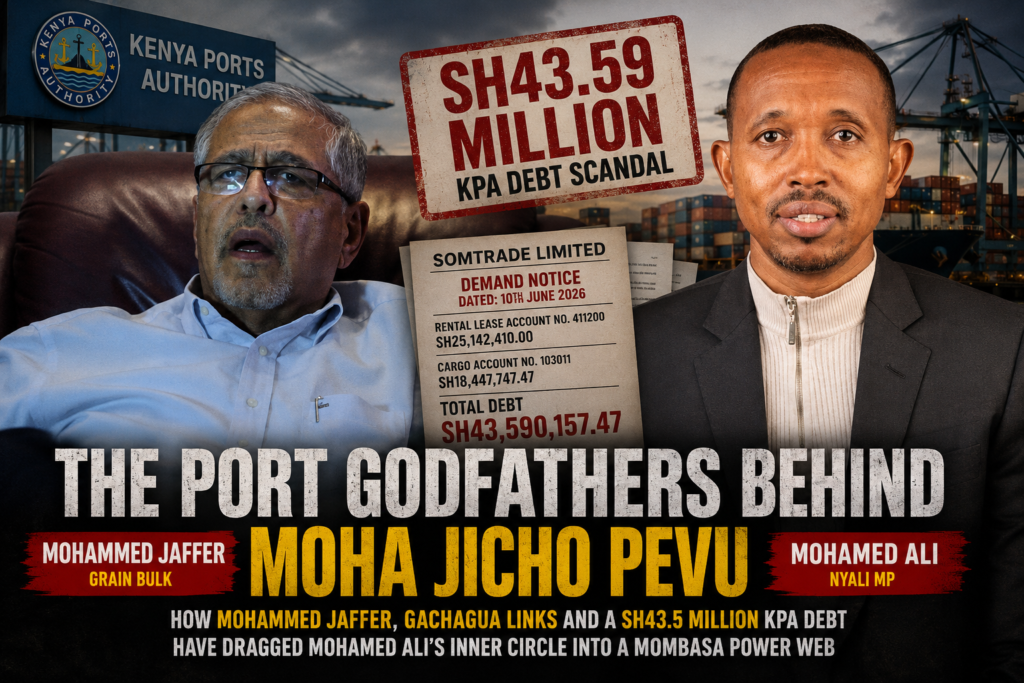
That is where the trouble begins. Because once a company tied to a sitting MP’s inner circle is staring at a Sh43.59 million KPA demand, the story stops being a private balance-sheet problem. It becomes a public question about how close politics, cargo business and port power have become on the Coast.
And it gets even darker when the names of former Deputy President Rigathi Gachagua and businessman Mohammed Jaffer of Grain Bulk begin surfacing in the same political conversation around Mohamed Ali’s rise and the people funding it.
A SH43.5 MILLION FILE NOW HANGING OVER MOHAMED ALI’S CAMP
According to documents and correspondence now in circulation, KPA issued Somtrade Limited with a demand dated June 10, 2026 over long-outstanding debts tied to both lease and cargo accounts. The figures are striking.
The company is said to owe Sh25,142,410.00 under Rental Lease Account No. 411200 and Sh18,447,747.47 under Cargo Account No. 103011. That takes the total claim to Sh43,590,157.47.
Those are not small arrears. They are not the sort of numbers that can be brushed aside as a temporary cash flow issue or a clerical misunderstanding. A debt of that size under a state authority does not build overnight. It grows over time. It survives reminders, statements, follow-ups and unanswered questions. It suggests a relationship that was already under strain long before the matter became public.
The documents indicate that the debt was linked to a lease arrangement involving Shade 2 on Title Number Mombasa/Block/1/492, under an agreement said to have been entered into between KPA and Somtrade Limited on November 21, 2023. If that timeline is accurate, then the issue is not just that Somtrade allegedly owes KPA money. It is that a company linked to politically exposed figures appears to have stayed within KPA’s commercial ecosystem long enough for the arrears to grow into a Sh43.59 million problem.
That raises a very simple question that Mohamed Ali’s camp cannot avoid. How did a company tied to his inner circle get this deep into debt under a public authority without the matter exploding much earlier?
THE NAEEM SHAFIQ CONNECTION CHANGES EVERYTHING
If Somtrade Limited had no visible connection to Mohamed Ali’s political orbit, this would still be a serious KPA debt story. But it would not be a political crisis for the Nyali MP.
What changes everything is Naeem Shafiq Mohamed.
The material now in circulation identifies Naeem as Somtrade’s largest shareholder with 30 shares. It also identifies him as a close confidant and personal assistant to Mohamed Ali, as well as a nominated MCA in the Mombasa County Assembly under UDA. That is not a loose or distant relationship. It is the kind of closeness that makes political distancing nearly impossible.
Mohamed Ali cannot pretend Naeem is some random businessman who happens to know him. If Naeem is indeed the largest shareholder in a company now facing a Sh43.59 million KPA debt demand, then the scandal moves right into Mohamed Ali’s backyard. It becomes a test of whether the anti-corruption crusader is willing to apply the same standards to his own camp that he applies so aggressively to everyone else.
The political danger here is obvious. Mohamed Ali has spent years attacking state corruption and presenting himself as a man above the old games of Coast politics. But when the largest shareholder in a debt-hit company is your own political aide, the moral high ground begins to crack.
The public is entitled to ask whether Mohamed Ali knew about Somtrade’s financial troubles, whether he was ever briefed on the KPA dispute, and whether anyone in his camp tried to intervene or shield the company from enforcement pressure. Those are fair questions because the people now appearing in the company records are not strangers to him. They are part of the machinery around him.
MOHAMED IBRAHIM ABDI’S NAME MAKES THE STORY HEAVIER
The second name in the company structure that deepens the scandal is Mohamed Ibrahim Abdi, the former Mombasa County Trade CEC.
That matters because Abdi is not just another businessman. He is a former senior county official with deep familiarity with trade systems, county administration and the political-commercial world that surrounds the port economy. Once his name appears inside the same company structure as Mohamed Ali’s aide, the story begins to look less like an isolated business problem and more like a window into a wider Coast power network.
A company linked to a sitting MP’s closest associate and a former county trade boss is not an ordinary private firm in the public imagination. It immediately raises questions about access, influence and whether those around it felt protected enough to keep operating even as the debt allegedly grew.
No one needs to invent conspiracy theories for the optics to already be bad. A company with this kind of political and administrative proximity now appears to be in a payment war with one of the most important state authorities on the Coast. That is a problem for everyone whose name sits inside the file.
KPA’S REPORTED POSITION MAKES THE DEBT LOOK EVEN UGLIER
One of the most damaging aspects of this story is KPA’s reported response to Somtrade’s attempt to negotiate a payment plan.
The documents suggest that Somtrade wrote to KPA asking for a structured plan to settle the arrears. But KPA is said to have rejected that request, reminding the company that the authority operates on a cash basis and does not offer credit facilities for the services it provides.
That single point creates a major accountability problem.
If KPA does not operate on credit, then how did Somtrade allegedly accumulate Sh43,590,157.47 in rental and cargo arrears? A debt of that size suggests the company was allowed to continue within the KPA ecosystem despite non-payment, or that enforcement mechanisms did not kick in when they should have.
Either possibility is serious. If Somtrade was allowed to remain in occupation or continue operations while the debt grew, the public is entitled to ask why. Was the company treated differently? Were there delays in enforcement? Did someone inside the system look the other way? Or was KPA simply unable to enforce its own rules against a company tied to politically connected names?
These are not small administrative questions. They go to the heart of how public authorities handle politically sensitive commercial relationships.
KPA’s reported warning that the debt was in contradiction to policy and could be treated as uncollectable due to the prolonged period only makes the story worse. It suggests the authority believed the matter had gone on too long and had already crossed from routine debt management into a more serious enforcement problem.
THE GACHAGUA QUESTION NOW HANGS OVER THE STORY
As the debt file grows heavier, another layer has begun to attach itself to Mohamed Ali’s name: the perception that his political impunity has been reinforced by closeness to Rigathi Gachagua.
That is an allegation and it should be treated carefully. But it is a politically important one because it speaks to the broader question of protection. In Mombasa political and business circles, Mohamed Ali has for some time been viewed by critics as a politician who has benefited from high-level political access while continuing to present himself as an outsider. The argument from his critics is simple: the public sees the rebel, but insiders see a politician with powerful friends and a growing network of business backers around the port economy.
Now place that perception next to a company linked to his aide facing a Sh43.59 million KPA demand, and the public naturally starts asking whether enforcement was delayed or softened because of the political names around the company. There may be no public proof of that. But the suspicion alone is politically dangerous.
Mohamed Ali’s closeness to Gachagua, whether current or historical, matters here because it feeds the central question running through the scandal: was Somtrade just another indebted company, or was it a company sitting under a political umbrella strong enough to believe consequences could be delayed?
That is a question Mohamed Ali cannot answer with slogans. It requires facts.
MOHAMMED JAFFER AND THE CAMPAIGN MONEY QUESTION
The story becomes even more uncomfortable for Mohamed Ali when the issue of campaign funding enters the frame.
Coast political circles have for months circulated claims that a section of cargo owners and operators around the Africa Salihiya space have been among the financial backers of Mohamed Ali’s political ambitions. The most sensitive name now being mentioned in those discussions is Mohammed Jaffer of Grain Bulk, who is described by sources in Mombasa as one of the key financiers associated with Mohamed Ali’s political machine.
That claim remains an allegation unless independently proven. But its significance lies in how it intersects with the Somtrade-KPA file.
If a politician is being backed by business players from the cargo and grain ecosystem, while at the same time a company linked to his aide is battling a Sh43.59 million KPA debt, then the public is no longer looking at separate stories. It begins to look like one larger story about port money, political funding and the commercial interests sitting behind a public anti-corruption image.
Mohammed Jaffer is not a casual name in Coast business. He is associated with serious commercial influence. Any suggestion that he is funding Mohamed Ali’s political rise would immediately raise difficult questions about what business interests are being aligned behind the MP and what those interests expect in return from a man seeking to deepen his political hold over Mombasa.
This does not prove wrongdoing. But it does deepen the conflict-of-interest questions around Mohamed Ali’s politics. Because once a politician is seen as a beneficiary of cargo-sector money while his own associates are tied to a massive KPA debt file, the line between public service and port business begins to look dangerously thin.
THIS IS NO LONGER JUST A DEBT STORY. IT IS A POWER MAP
The easiest way to misunderstand this scandal is to reduce it to one line: “Somtrade owes KPA money.”
That is far too small.
This is now a story about how power on the Coast is financed, protected and disguised. It is a story about a sitting MP who built his relevance by attacking corruption, yet now finds himself surrounded by a debt scandal involving his closest aide. It is a story about a former county trade boss sitting inside the same company structure. It is a story about allegations of political protection linked to Gachagua. And it is a story about claims that powerful cargo and grain players, including Mohammed Jaffer, are helping bankroll the same politician’s rise.
Put those pieces together and a darker picture emerges. Not a random company debt. Not a simple billing disagreement. But a political-commercial web where port business, campaign financing and personal influence may be intersecting in ways the public has every right to scrutinise.
That is why Mohamed Ali’s silence on the issue matters. If the story were truly distant from him, he would be free to dismiss it. But it is not distant. It is sitting too close to the people around him.
KPA ALSO HAS QUESTIONS TO ANSWER
This scandal does not end with Somtrade and Mohamed Ali’s circle. KPA itself has a serious accountability problem if the documents are accurate.
If the authority operates on a cash basis, why was a debt of Sh43.59 million allowed to build? At what point did KPA realise the arrears had reached dangerous levels? Were warning letters issued early enough? Was the lease relationship reviewed? Were cargo services allowed to continue despite the arrears? Did any internal officers fail to enforce policy? Were exceptions quietly made because of who was behind the company?
These are uncomfortable questions for KPA because they suggest the authority may have either failed to enforce its own systems or allowed a politically sensitive file to grow for too long. A debt of this size does not simply materialise. It passes through desks, statements, reminders, meetings and internal decisions. That means the KPA side of this story may eventually become as important as the Somtrade side.
If KPA wants to protect its own credibility, it must explain how the debt arose, how long it was allowed to accumulate and what action was taken at each stage.
MOHAMED ALI NOW FACES A CREDIBILITY TEST HE CANNOT SHOUT AWAY
The biggest damage this scandal does to Mohamed Ali is not legal. It is moral and political.
He has spent years building a reputation as a man who spots rot in other people’s houses. But the public is now being asked to look at a Sh43.59 million KPA debt, a company linked to his aide, a former county trade official in the same company, allegations of political protection from Gachagua, and claims of campaign funding from cargo and grain interests including Mohammed Jaffer.
That is a devastating mix for a politician whose power depends so heavily on appearing cleaner than the system around him.
Mohamed Ali cannot hide behind the argument that his name is not on Somtrade’s company records. Politics is not only about what is written in a CR12. It is about proximity, influence and the people you choose to surround yourself with. If your closest aide is the biggest shareholder in a company under a Sh43.59 million KPA debt cloud, then that cloud drifts toward you whether you like it or not.
He now owes the public clear answers.
Did he know about Somtrade’s KPA debt? Did Naeem Shafiq ever brief him on the matter? Did anyone in his office seek to intervene or soften the fallout? What is his relationship with Mohammed Jaffer and other cargo-linked financiers said to be backing his politics? And what exactly is the nature of the political and business network that now seems to be forming around him?
Those questions matter because Mohamed Ali is not an ordinary businessman. He is a sitting MP who has made anti-corruption his political currency. If that currency is to retain any value, he must answer the questions now hanging over his own camp with facts, not anger.
THE STORY IS NOW BIGGER THAN MOHA
At this point, the Somtrade-KPA debt file is no longer just about Mohamed Ali, Naeem Shafiq or one company’s alleged arrears. It is becoming a test case for how politics, business and port power are intertwined on the Coast.
It raises questions about whether politicians can publicly posture as reformers while privately relying on the same commercial networks they condemn. It raises questions about whether state authorities enforce their rules equally when politically connected names are involved. And it raises questions about whether campaign financing from cargo and grain players is quietly shaping the future of Mombasa politics behind the scenes.
That is why this story is not going away.
The public has now seen enough to ask a simple but devastating question: was Mohamed Ali fighting corruption, or was he simply fighting other people’s corruption while his own circle built a debt scandal at the port?
Until Mohamed Ali, Somtrade, KPA and the business names now orbiting this file answer that question properly, the Sh43.59 million KPA debt will remain more than a commercial dispute.
It will remain a symbol of the very thing Mohamed Ali once promised to destroy: a political system where power, money and public institutions become too entangled to tell where one ends and the other begins.
