
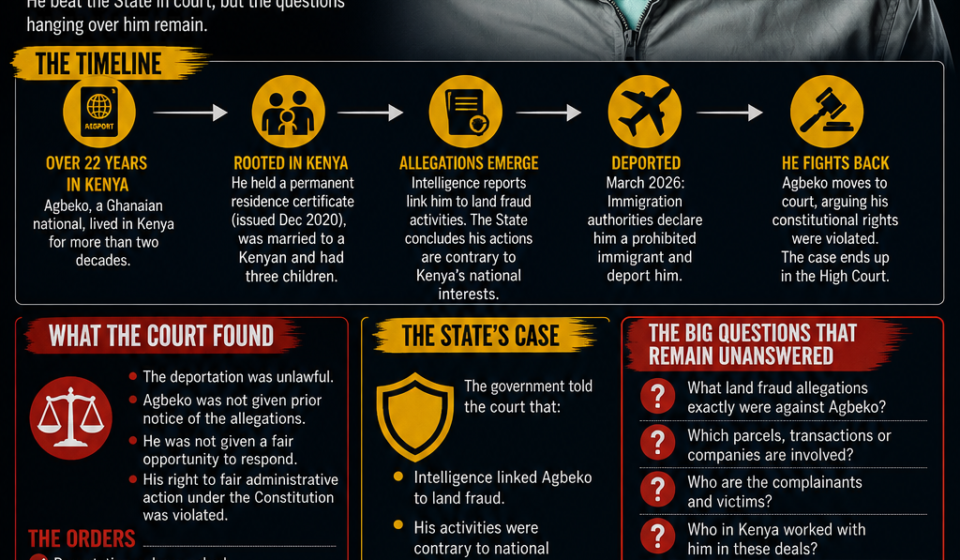
Court Saved Erick Agbeko From Deportation, But It Did Not Bury the Land Fraud Questions Hanging Over Him

Last Updated on June 23, 2026 by Joao Pedro
For Erick Agbeko, the High Court’s decision to quash his deportation from Kenya was a major legal victory.
For the Kenyan State, it was an embarrassing rebuke.
And for the public, it should be a warning not to confuse a procedural court win with a clean bill of health.
Because stripped of the legal jargon and courtroom formalities, the ruling did two things at once. It rescued a Ghanaian businessman from a deportation process the court found unconstitutional, unlawful and procedurally defective. But it also left hanging in the air a far more uncomfortable question that the judgment did not answer and the government has still not properly confronted in public: what exactly are the land fraud allegations that made the State want Erick Agbeko out of Kenya in the first place?
That is the real story here.
Not simply that a businessman won in court.
Not simply that immigration officials were slapped down.
But that Kenya tried to remove a foreign national on grounds serious enough to invoke land fraud, national interest and the law on prohibited immigrants — and then bungled the process so badly that the man walked away with KSh2 million in compensation, a quashed deportation order and a court declaration that his rights had been violated.
That is not just a courtroom loss.
It is an institutional collapse.
It is the kind of failure that turns a potentially serious State case into a public relations disaster and gives the target of government action an opportunity to look persecuted, even when the deeper allegations against him have not actually been tested and cleared in court.
And that is exactly why the Erick Agbeko case deserves far more scrutiny than a simple “court overturns deportation” headline.
A Court Win, But Not a Full Cleansing of His Name
The easiest mistake the public can make in reading the High Court decision is to assume that because Agbeko won, the allegations against him were false.
That is not what the judgment says.
The court did not hold a trial on whether Erick Agbeko committed land fraud.
It did not make a final factual determination that the State fabricated the accusations.
It did not issue a finding declaring him innocent of every claim swirling around his name.
What the court did was narrower, but still devastating for the government: it found that the State violated Agbeko’s constitutional rights by declaring him a prohibited immigrant and deporting him without giving him a meaningful opportunity to know the allegations and respond to them before the decision was made.
That distinction is everything.
Agbeko won on process.
He won on fair administrative action.
He won because the State acted unlawfully in how it removed him.
But that is not the same as a court saying the allegations that triggered the State action were imaginary or disproved.
And that is why the case remains politically and commercially explosive.
Because it means Kenya now has a businessman who has beaten deportation in court while still carrying the shadow of allegations serious enough for the State to say his presence in the country was contrary to national interests.
What the Government Told the Court
According to the case as argued by the State, immigration authorities and the Interior Ministry were acting on intelligence reports that allegedly linked Agbeko to land fraud activities.
The government’s position was not a minor one.
This was not a dispute over visa overstay or a missing immigration stamp. State lawyers reportedly defended the deportation by arguing that intelligence shared with immigration authorities indicated that Agbeko was involved in land fraud and that his activities were contrary to national interests. That is the kind of language the State uses when it wants to justify extreme administrative action.
In other words, the government was effectively saying: this is not just a foreign businessman we don’t like. This is a man whose activities are serious enough to justify declaring him a prohibited immigrant and removing him from the country.
That is a massive allegation.
And it should have triggered a careful, disciplined, evidence-backed process if the State was serious.
Instead, the government appears to have done what Kenyan institutions too often do when faced with a difficult case: it reached for a blunt instrument, ignored constitutional safeguards and then acted surprised when the courts struck it down.
The State’s Own Sloppiness Handed Agbeko a Lifeline
If there is one villain in the judgment, it is not necessarily the businessman.
It is the recklessness of the State.
The High Court found that the process culminating in Agbeko’s deportation fell short of the Constitution. He was not given prior notice in a meaningful way. He was not accorded a proper opportunity to challenge the allegations before being branded a prohibited immigrant and pushed out. The court found that this conduct violated the standards of fair administrative action and constitutional due process.
That finding is damning because it means the government may have had serious allegations but still chose to proceed in a way that almost guaranteed the entire action would collapse under judicial scrutiny.
And that is the bigger scandal.
Because if the State truly believed Agbeko was involved in land fraud, then the government itself destroyed the credibility of its own case by trampling procedure. It transformed what could have been a strong legal confrontation into a constitutional own goal. It handed Agbeko a platform to present himself as a victim of abuse. And it shifted public attention away from the underlying allegations and onto the State’s misconduct.
That is a gift no serious enforcement agency should ever hand to a target.
Yet Kenya did exactly that.
Twenty-Two Years in Kenya and Still a Mystery
One of the most striking details in the case is how deeply rooted Agbeko had already become in Kenya before the deportation drama erupted.
By the time he was deported in March 2026, he had reportedly lived in the country for more than 22 years. He held a permanent residence certificate issued in December 2020. He was married to a Kenyan citizen. He had three children. This was not the profile of a transient foreign operator who had just landed in Nairobi and vanished into shady transactions.
This was someone who had built a long-term life, business footprint and legal status inside the country.
That makes the case even more troubling.
Because if the government truly believed that a man who had lived in Kenya for over two decades was involved in land fraud serious enough to threaten national interests, then the obvious question is: what was happening during those twenty-two years?
What land dealings was he involved in?
Which companies did he use?
Who were his local associates, lawyers, agents and business partners?
How many disputes, complaints or warnings had emerged before the State resorted to deportation?
Why did it take this long for immigration and security agencies to move?
And if the intelligence was strong enough to justify such a dramatic action, why was the State still so poorly prepared when the case reached court?
These are not side questions.
They are the heart of the public interest.
The Danger of Mistaking Procedure for Innocence
Kenya has a long and dangerous habit of confusing procedural victories with substantive innocence.
A suspect gets acquitted because evidence was mishandled, and suddenly the public treats them as fully vindicated.
A government agency violates due process, loses in court, and the person at the centre of the case begins to look like a saint.
A file collapses because officers were lazy, reckless or corrupt, and the deeper wrongdoing quietly disappears behind headlines about rights violations.
That is exactly the trap this case now presents.
Erick Agbeko’s legal victory is real and important. If the State violates your rights, the courts must intervene. That principle matters whether the person in question is a Kenyan citizen, a foreign investor, a political dissident or someone facing ugly allegations. Due process is not optional. It is the difference between lawful governance and State abuse.
But due process is not the same thing as exoneration.
The High Court was saying the government did not follow the law in how it treated him.
It was not saying the public should stop asking why the State was linking him to land fraud in the first place.
And that is where the Kenyan public must resist the temptation to stop reading after the first victory.
Why the Land Fraud Shadow Still Matters
Land fraud is not a side issue in Kenya.
It is one of the country’s most entrenched criminal economies.
It destroys families, wipes out investments, fuels violence, corrupts registries, recruits insiders in government offices and turns the justice system into a graveyard of stalled cases. Entire fortunes have been built in Kenya through forged titles, double allocation, illegal transfers, fake succession battles, fraudulent leases and political protection of grabbed land.
So when the State tells a court that a foreign businessman was linked to land fraud activities serious enough to justify immigration action, that cannot be treated as a throwaway line.
It must be unpacked.
If those allegations were weak, the public deserves to know why the State invoked them so recklessly.
If those allegations were strong, the public deserves to know why the government chose the sloppiest possible route to act on them.
Either way, somebody in government has a lot of explaining to do.
Because the current situation satisfies nobody.
It does not fully clear Agbeko in the court of public opinion.
And it does not make the State look competent, lawful or credible.
It only exposes a dangerous vacuum where serious allegations exist, but the institutions responsible for pursuing them appear unable to do so cleanly.
Deportation Is Not a Substitute for Prosecution
Another uncomfortable truth exposed by this case is how often the Kenyan State seems to prefer administrative shortcuts over building proper cases.
If a foreign national is suspected of involvement in land fraud, the State has tools available.
It can investigate.
It can summon.
It can freeze or trace suspicious transactions if the law allows.
It can coordinate with the DCI, EACC, ODPP, the Ministry of Lands and other agencies where appropriate.
It can prosecute if there is evidence of criminal conduct.
It can support civil recovery or cancellation of titles if the legal basis exists.
What it should not do is behave as though deportation is a magic wand that erases the need to prove the allegations.
Deportation is dramatic. It makes headlines. It creates the image of decisive action. But it is not a replacement for a lawful, evidence-based case. And when used badly, it can backfire spectacularly — exactly as it has here.
By deporting first and thinking later, the government may have sabotaged its own ability to pursue the more important issue: the alleged land fraud itself.
Now the case is no longer centred on the alleged conduct. It is centred on the State’s abuse of power.
That is a serious strategic failure.
The Government Made It About Itself
The saddest part of this case is how the State managed to turn the spotlight away from the allegations and onto its own misconduct.
Instead of the public asking, “What exactly was Agbeko accused of doing?” the dominant question became, “Why did the government violate his rights?”
Instead of the government walking into court with a disciplined explanation and a fair process, it walked in with a constitutional mess.
Instead of exposing a suspected land fraud network, it exposed its own disregard for procedure.
That shift matters because it changes the emotional centre of the story. Once the State is found to have acted unlawfully, sympathy begins to drift toward the person it targeted. The businessman starts to look like the wronged party. The government becomes the bully. The deeper allegations get pushed into the background. And the possibility of a more serious public reckoning starts to fade.
That is why sloppy enforcement is not a technical issue.
It can completely reverse the narrative of a case.
Who Helped Him Operate?
The public-interest value of the Agbeko case lies not just in his own role, but in the ecosystem around him.
No major land operator in Kenya functions in a vacuum.
If there were indeed credible concerns around his land dealings, then the bigger story is likely to sit in the network around him — the lawyers, brokers, surveyors, registry insiders, local business partners, proxies and politically connected fixers who make disputed land transactions possible.
That is why the case should not end with the quashing of a deportation order.
It should begin there.
The public deserves to know whether there are parcels under dispute, court cases tied to his name, companies linked to his transactions or complainants who say they were wronged. It deserves to know whether any state agencies other than immigration had active files on him. It deserves to know whether the intelligence reports cited in court were built on actual complaints, ongoing investigations or mere suspicion. And it deserves to know whether the government is now willing to pursue those issues lawfully, or whether it has already given up after losing the deportation battle.
A State That Wants to Look Tough but Works Sloppily
There is a wider lesson here about how the Kenyan State performs power.
Too often, institutions want the optics of toughness without doing the boring work of building lawful cases. They want dramatic removals, splashy arrests and forceful declarations. They want to look decisive. But when the time comes to justify those actions before a court, the paperwork is thin, the process is broken and the constitutional basics have been ignored.
That is not strength.
It is amateurism dressed as authority.
And in a country already drowning in land disputes, that kind of amateurism is dangerous. It means real cases can collapse. It means victims can be denied justice. It means alleged fraudsters can walk away empowered. And it means public confidence in the State’s ability to tackle economic crime sinks even lower.
That is what the Agbeko case now represents.
Not just a businessman’s court victory.
But a government’s failure to convert serious allegations into a lawful, credible and sustainable case.
The Questions That Refuse to Die
Even after the judgment, the most important questions remain unanswered.
What exactly did the intelligence reports say about Agbeko’s alleged land activities?
Were there specific parcels, complainants or transactions at the centre of the concern?
How long had the State been monitoring him before the deportation decision?
Why was deportation chosen instead of a more transparent and legally durable route?
Who in government authorised a process so procedurally weak that it collapsed in court?
And most importantly, is the State now prepared to pursue the underlying allegations lawfully, or was the deportation always a substitute for doing the hard work of proving its case?
Until those questions are answered, the case will remain unfinished.
The Real Verdict
The High Court has already delivered its verdict on one issue: the government violated Erick Agbeko’s rights and acted unlawfully in deporting him.
But the public has not yet received a verdict on the issue that matters just as much — whether the land fraud concerns cited by the State were baseless, exaggerated, or the first visible crack in a much larger story about how foreign-linked land dealings operate in Kenya.
That is why this is not a story about a man who has been fully cleared.
It is a story about a man who beat the State because the State broke the rules.
It is a story about a government that invoked land fraud and national interest, then failed to act in a way the Constitution could sustain.
And it is a story about a country where serious allegations can be swallowed by procedural incompetence, leaving the public with a court victory, a compensation award and a long trail of unanswered questions.
For Erick Agbeko, the deportation has been quashed.
For the Kenyan government, the embarrassment is now on record.
But for the rest of the country, the most important chapter still has not been written — the chapter that explains what exactly the State believed he had done, who helped him do it if the allegations were true, and why Kenya was prepared to throw him out before it was prepared to prove its case properly.
Until that chapter is written, this story is not over.
It has only changed shape.