
COURT BATTLE LOOMS AS BRANDPULSE DEMANDS KSH4.7 MILLION OVER UNPAID PINY LUO FESTIVAL DEAL, PUTTING MIGORI OFFICIALS AND ELGON GROUP ON THE SPOT

Last Updated on June 23, 2026 by Joao Pedro
A payment dispute over the 2025 Piny Luo Festival is now threatening to spill into a full legal and public accountability battle after a Nairobi-based branding firm accused Migori County, senior county finance officials and parties linked to the event of failing to settle more than KSh4.7 million for work already delivered.
At the centre of the dispute is BrandPulse Experience, trading as Lokhart SIPE Ltd says their company carried out branding services for the high-profile cultural festival but has been left chasing payment for months despite repeated follow-ups, formal letters and direct appeals to officials linked to the project.
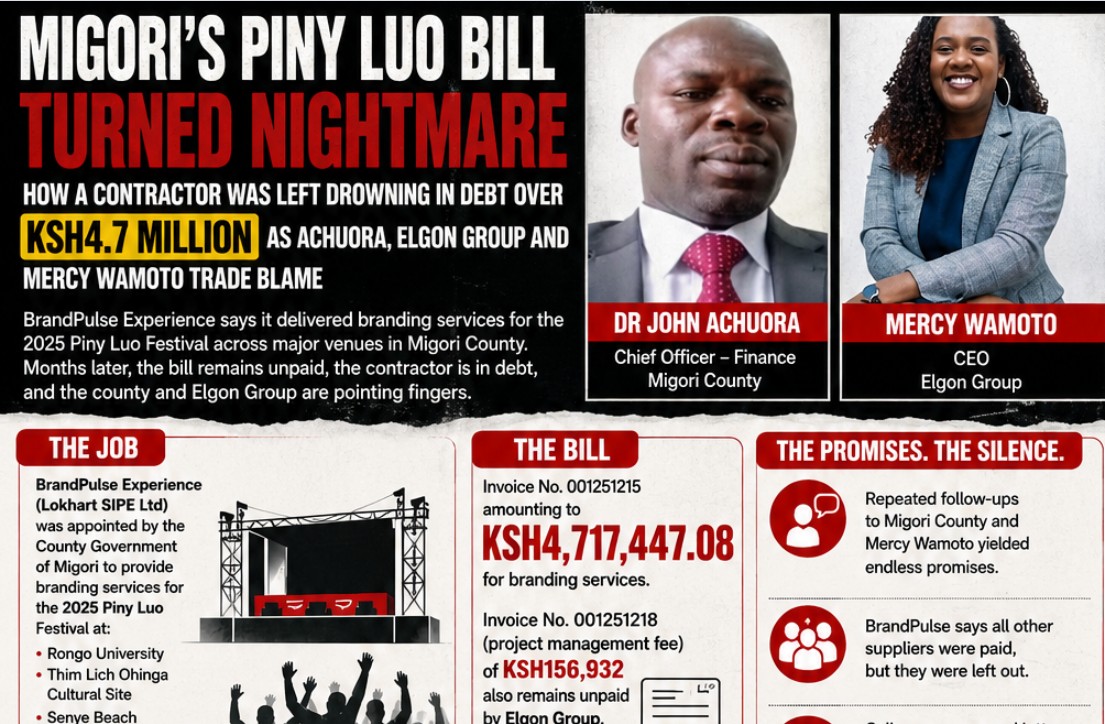
The dispute now places Migori County Chief Officer for Finance Dr John Achuora and Elgon Group CEO Mercy Wamoto under scrutiny, with conflicting accounts emerging over whether money meant for BrandPulse was ever released and, if so, who was responsible for remitting it to the contractor.
For a matter that began as a supplier payment issue, the case is quickly taking on the features of a wider governance scandal. Documents and WhatsApp messages seen by this publication suggest that the contractor has been trapped in a prolonged blame game between county officials and private actors associated with the event, even as he struggles under the financial pressure of an unpaid invoice tied to work he says was completed months ago.
THE KSH4.7 MILLION CLAIM
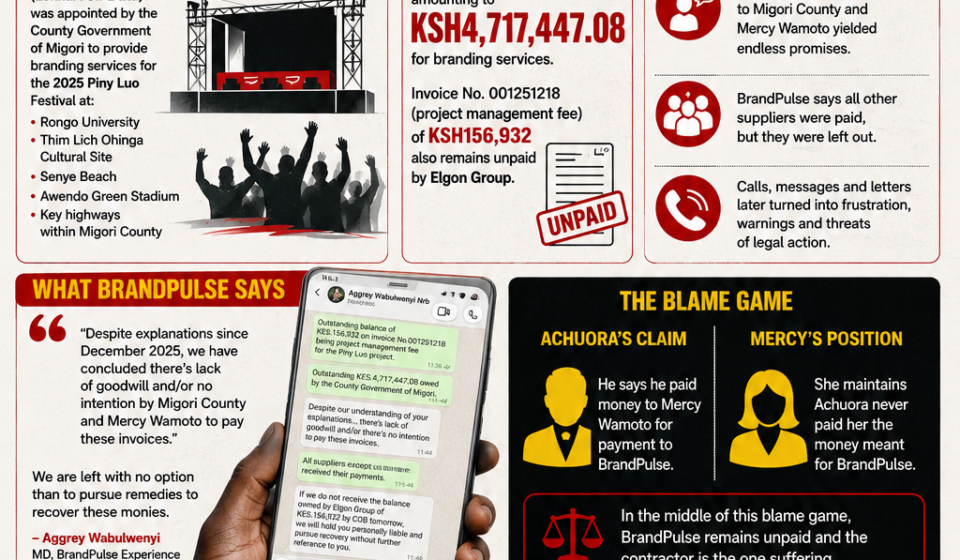
The core of the dispute is straightforward. BrandPulse says it was appointed to provide branding services for the Piny Luo Festival 2025, an event staged across multiple venues in Migori County and promoted as a major cultural and tourism showcase. According to a formal letter dated March 9, 2026, the company says it provided branding services at Rongo University, Thim Lich Ohinga Cultural Site, Senye Beach, Awendo Green Stadium and along key highways within Migori County.
In that letter, addressed to the Principal Secretary, State Department for Culture, the Arts and Heritage, BrandPulse states that Invoice No. 001251215 for KSh4,717,447.08 remained unpaid despite several follow-ups with county offices.
The letter further states that the continued delay had caused strain to the company’s operations and affected suppliers who supported the delivery of the festival branding work. The complaint was copied to the County Secretary, County Government of Migori, as well as Elgon Group Ltd, indicating that the dispute had already moved beyond informal follow-up and into formal escalation.
That letter is important because it establishes several things at once. First, it identifies a specific invoice and amount. Second, it places the County Government of Migori at the centre of the payment dispute. Third, it shows that by March 2026, the contractor had escalated the matter beyond county offices and was seeking intervention from the national government’s culture docket.
WHATSAPP MESSAGES REVEAL GROWING FRUSTRATION
In one message, he states that BrandPulse delivered branding services for the 2025 Piny Luo Festival under a duly signed contract with the County Government of Migori, but the company’s invoice of KSh4,717,447.08 remained unpaid despite multiple follow-ups.
In another message dated March 10, 2026, Wabulwenyi refers to two outstanding amounts. The first is KSh156,932, described as an outstanding balance on invoice number 001251218 for project management fees linked to the Piny Luo project. The second is the much larger KSh4,717,447.08 said to be owed by the County Government of Migori.
In the same communication, Brand pulse says that since December 2025, when the project was completed, BrandPulse had received repeated explanations over the delay but had now concluded there was a lack of goodwill and no real intention to settle the invoices. He also claims the company had learnt that other suppliers had already been paid, leaving BrandPulse as the only party still carrying losses from the project.
He goes further to warn that if BrandPulse did not receive the KSh156,932 balance allegedly owed by Elgon Group by close of business the following day, the company would hold Mercy personally liable and pursue recovery without further reference.
The language used in the messages suggests a contractor who had moved beyond ordinary follow-up and was now considering recovery action. It also raises a key legal and factual question: what exactly was the relationship between the county, Elgon Group and BrandPulse in the payment structure for the festival?
THE ACHUORA-MERCY PAYMENT DISPUTE
That question becomes even more important in light of the conflicting positions now said to exist around the unpaid money.
According to information now emerging around the dispute, Dr John Achuora is said to maintain that he paid money to Mercy Wamoto for onward settlement of BrandPulse’s dues. Mercy, on the other hand, is said to maintain that Achuora never remitted the money meant for BrandPulse.
If those competing accounts are accurate, then the dispute is no longer just about delayed payment. It becomes a matter of tracing the movement of public or event-related funds and establishing who, if anyone, was entrusted with settling the supplier’s invoice.
That is why the spotlight is now turning sharply to Migori County’s finance office. Dr Achuora is not a peripheral figure in this matter. As Chief Officer for Finance, he sits at the heart of county payment systems and is one of the officials expected to know whether a claim of this size was approved, processed, withheld or settled through an intermediary arrangement.
If the county released money for BrandPulse’s work, there should be a paper trail showing when the payment was approved, how much was paid, the recipient and the purpose of the remittance. If no payment was released, that too should be clear from county records. If money was sent to a third party to handle settlement, the county should be able to explain the legal and contractual basis of that arrangement.
At the moment, however, the contractor appears to be caught between two narratives. One side says the money was paid out. The other side says it was not. Yet the one uncontested fact is that BrandPulse says it has still not received the KSh4.7 million it claims for branding services rendered.
POSSIBLE LEGAL ISSUES EMERGING FROM THE DISPUTE
Viewed through a legal lens, the dispute raises several possible issues.
The first is whether there was a valid and enforceable contractual relationship between BrandPulse and the County Government of Migori, and whether the services claimed were duly delivered and accepted. If that can be established through appointment letters, delivery records, approvals and invoice acknowledgments, then the company may have a clear basis for pursuing recovery through the courts.
The second issue is whether Elgon Group had any contractual or agency role in relation to the branding work or the payment chain. The separate claim for KSh156,932 described as a balance owed by Elgon suggests that Elgon may have had its own financial obligations to BrandPulse, distinct from the county invoice. If so, the legal position of Elgon Group in the broader dispute will become critical.
The third issue is whether public funds earmarked for event suppliers were processed properly and transparently. If a county finance office released money intended for a supplier but the supplier never received it, then questions arise about accountability, documentation and fiduciary responsibility. If the county did not release the money at all, then the issue becomes one of delayed public payment and possible breach of contractual obligations.
The fourth issue is the potential financial harm suffered by the contractor. Wabulwenyi is said to have financed part of the work through borrowed funds, including a loan from Ecobank, in order to execute the project. If that claim is accurate, the prolonged delay may have exposed the company not only to direct loss of income but also to loan servicing pressure, reputational damage with lenders and broader operational strain.
A CONTRACTOR UNDER PRESSURE
Behind the figures and correspondence is a more human story. Wabulwenyi says the delay has left him under severe financial strain after taking on the work and allegedly borrowing to finance execution. In Kenya’s public procurement environment, that is a familiar but dangerous pattern. Contractors often commit resources upfront in the expectation that county governments or public bodies will settle invoices once work is done. When those payments delay for months, the supplier is left to carry interest, payroll strain, creditor pressure and reputational risk.
This is one reason county payment disputes have become so destructive to small and medium-sized contractors. A pending invoice on the county’s side may look like a file waiting for approval. On the supplier’s side, it can mean a loan in arrears, unpaid staff, stalled operations and mounting psychological pressure.
In this case, the contractor’s messages suggest the pressure has become severe. He is no longer simply asking when he will be paid. He is accusing those involved of lacking goodwill and of abandoning his company while others were paid.
WHY THIS DISPUTE MATTERS BEYOND ONE SUPPLIER
The Piny Luo payment row matters because it speaks to a wider problem in county procurement and event contracting. Public events often involve a chain of actors: county departments, event organisers, consultants, branding firms, logistics providers and private agencies. When those chains are poorly structured or poorly documented, disputes over payment can quickly become murky. A supplier may know the work was done and the invoice was submitted, but not whether the county was to pay directly, whether an event consultant was to settle part of the bill, or whether money was released through another entity.
That uncertainty creates fertile ground for finger-pointing. By the time the supplier starts demanding answers, one office says finance has not released money, another says the file is pending, and another says payment was sent elsewhere. The result is exactly what appears to be happening here: a contractor left holding the debt while the parties around the transaction dispute the money trail.
For Migori County, the dispute also carries reputational risk. Counties rely heavily on private suppliers to execute public events, branding, road works, communication campaigns and development projects. When a contractor says he delivered work for a county-backed event and has spent months chasing KSh4.7 million, future suppliers take note. It sends a warning that doing business with the county may carry serious payment risk.
QUESTIONS MIGORI COUNTY AND ELGON GROUP MUST ANSWER
Several questions now demand direct answers from the parties involved.
Did the County Government of Migori appoint BrandPulse to provide branding services for the Piny Luo Festival 2025? Was Invoice No. 001251215 for KSh4,717,447.08 formally received, approved or certified? If so, what action was taken on it?
Did Migori County release any money linked to that invoice? If yes, to whom was it paid, on what date and under what authority?
What role, if any, did Elgon Group play in the contracting or payment structure for the festival branding work? Was Elgon expected to settle any part of BrandPulse’s dues? What is the basis of the separate KSh156,932 claim raised by Wabulwenyi against Elgon Group?
If Dr Achuora’s position is that money was paid to Mercy Wamoto or to an entity associated with her for onward remittance, what documentary proof exists to support that claim? If Mercy’s position is that no such money was received, what records support her account?
These are not speculative questions. They go directly to the heart of the dispute and to the issue of who, in legal and financial terms, bears responsibility for the unpaid amount.
WHAT HAPPENS NEXT
Unless the matter is resolved quickly, the dispute appears headed toward one of two paths: a formal legal recovery process or a deeper public scandal involving county procurement and payment practices.
For BrandPulse, the likely legal route would be to rely on appointment letters, invoices, delivery evidence, correspondence and payment follow-ups to establish that the county or another liable party failed to settle a valid debt. If Elgon Group had a separate contractual obligation, that too could become part of recovery proceedings.
For Migori County and any private party involved, the greater risk may not only be a court claim but also the public perception that a county-backed event used private suppliers and then left them to fend for themselves after the publicity had been secured.
At the moment, the most urgent issue is transparency. If the county owes the money, it should say so and settle it. If it paid the money to another party, it should produce the records and explain the arrangement. If Elgon Group owes a separate amount, it should clarify its position and deal with it. What cannot continue is a situation in which a contractor remains unpaid while those at the centre of the dispute trade competing accounts behind closed doors.
A TEST OF ACCOUNTABILITY
The Piny Luo Festival payment row has now become more than a billing disagreement. It is a test of how Migori County handles suppliers, how its finance office accounts for county-linked obligations and whether private firms engaged in public-facing events can expect to be paid without having to chase money through months of letters and personal messages.
For BrandPulse, the issue is immediate and personal. For Migori County and Elgon Group, it is now a matter of accountability.
The county, Dr John Achuora and Mercy Wamoto owe the public a clear answer. Was the money paid, who was supposed to pay BrandPulse, and why is a contractor still chasing KSh4,717,447.08 long after the Piny Luo Festival ended?
Until those questions are answered with documents rather than shifting explanations, the dispute will remain a live scandal with serious legal consequences waiting just around the corner.