


Last Updated on February 6, 2026 by courtnews reporter
KETRACO Deleted Web Page on $240 Million SGR Electrification Deal Raises Questions
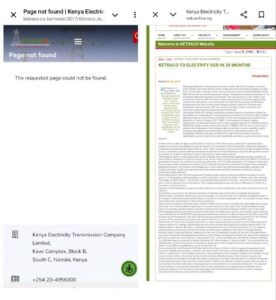
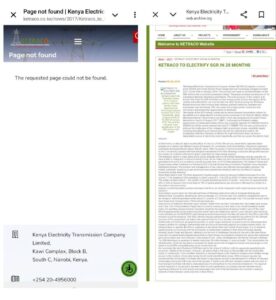
The Kenya Electricity Transmission Company Limited (KETRACO) has deleted a web page detailing a $240 million project under which the government agency was to electrify the Standard Gauge Railway (SGR) line between Mombasa and Nairobi.
The deleted page outlined a major infrastructure project intended to transition the SGR from diesel-powered locomotives to electric traction, through the construction of 14 power substations along the corridor.
The disappearance of the page has raised fresh questions about the status of the project, which was expected to be completed by 2021 but has yet to materialise.
Project Intended to Power SGR With Clean Energy
In the now-deleted publication, KETRACO stated that the project aimed to ensure reliable and sufficient electricity supply not only for the SGR trains but also for facilities along the Mombasa–Nairobi economic belt.
According to the agency, the electrification was expected to support train stations, planned industrial parks, factories, and businesses located near the railway line.
“This will create more major power customers and consumers and bring other opportunities to the locals,” KETRACO stated in the article.
Contract Signed in 2018 Under Fernandes Barasa
The electrification contract was signed on January 25, 2018, between KETRACO and China Electric Power Equipment and Technology Company Limited (CET).
At the time, KETRACO was headed by Fernandes Barasa, who is now the Governor of Kakamega County.
The project was designed to connect the SGR to KETRACO’s 482-kilometre 400kV Mombasa–Nairobi Transmission Line (MNTL), which was commissioned in August 2017 and has a transfer capacity of 1,500MW.
Contradicting Views on Project Viability
Before the financing arrangement, Barasa authored a public opinion article arguing that the electrification project was viable and necessary.
However, this position was publicly contradicted by the then Managing Director of Kenya Railways Corporation, Atanas Maina, who stated that the government lacked the financial capacity to convert the SGR from diesel to electric power.
The project has since stalled, leaving the SGR operating on diesel more than a decade after construction began.
Regional Comparisons Raise Cost Concerns
The stalled electrification has reignited debate over the cost of Kenya’s SGR compared to similar projects elsewhere in Africa.
For instance, Ethiopia constructed a 750-kilometre electric railway at an estimated cost of $3.4 billion, while Kenya’s 472-kilometre SGR reportedly cost about Sh447 billion, despite remaining diesel-powered.
Other African countries such as Morocco and Tanzania have also implemented rail projects at comparatively lower costs, some with built-in electrification.
SGR Electrification and Climate Commitments
The deleted KETRACO article strongly linked the SGR electrification project to Kenya’s climate commitments, citing statements made by former President Uhuru Kenyatta at the COP21 Global Climate Summit in Paris.
The article referenced World Bank data showing that the transport sector accounts for a significant share of global carbon emissions and argued that electric rail systems offer a cleaner alternative to road and air transport.
According to international rail studies cited, rail transport emits three to ten times less CO₂ per passenger kilometre compared to road or air travel.
Project Status Remains Unclear
Despite the ambitious projections outlined in the original publication, the SGR electrification project has not been completed, and KETRACO has not publicly explained why the web page detailing the deal was removed.
The deletion has renewed calls for greater transparency and accountability regarding large public infrastructure projects and their financing.
Kenya Court News Today – Live High Court & DPP Updates click here 👉 /kenya-court-news-today