

Last Updated on September 15, 2025 by
Honey Khatwani Oki Trading fraud
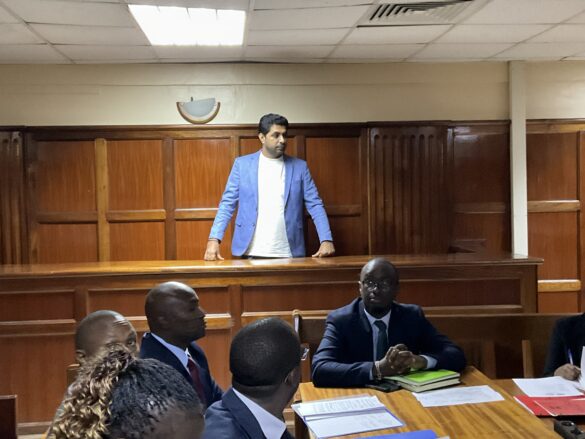
The Milimani Law Courts in Nairobi have been told how Honey Khatwani, a former director of Oki Trading Kenya Limited (OTCL), allegedly orchestrated the theft of over KSh 356 million from the company before resigning and setting up his own competing business.
The case, which has attracted widespread attention in both business and legal circles, underscores growing concerns over corporate fraud and accountability in Kenya.
Testimony from Current Oki Trading Director
Testifying before Senior Principal Magistrate Dolphina Alego, the current director of Oki Trading Kenya, Deepak Rajoria, painted a picture of systematic fraud carried out over several years.
Rajoria, who previously worked for the company’s parent firm in Dubai, was appointed as a director of the Kenyan subsidiary in January 2024. Upon assuming his new role, he quickly discovered that crucial funds and financial documents were missing.
According to his testimony, it became evident that the alleged fraud was not a one-off incident but rather a well-planned scheme spanning several years.
How the Money Was Allegedly Diverted
Rajoria testified that his predecessor, Honey Khatwani, who had been entrusted with running the company in Kenya, diverted massive sums of money into his personal accounts and used the funds to set up a rival company.
Among the allegations raised in court were that Khatwani:
-
Set up Galaxy Middle East Africa Limited — a company in the same line of business as Oki Trading — using money stolen from Oki.
-
Diverted company funds and client cheques into his personal bank account and into M-Pesa accounts registered under his name and his wife’s name.
-
Issued fake invoices that showed lower amounts than what clients had actually paid, pocketing the difference.
-
Misappropriated funds between 2021 and 2024, during which time he served as a company director.
Rajoria further told the court that Khatwani’s fraudulent conduct severely undermined the financial stability of Oki Trading in Kenya and damaged its reputation among clients.
Auditor’s Findings Confirm Missing Millions
The discrepancies led the company to commission a forensic audit. The audit confirmed that between 2021 and 2024, Oki Trading Kenya had lost KSh 356,711,806.
The auditors also traced a pattern of financial mismanagement and irregular deposits, strengthening suspicions that the funds had been deliberately siphoned off.
According to court documents, Khatwani allegedly authorized the diversion of large sums, including client payments, into his personal accounts rather than the company’s official bank accounts.
The Official Charges Against Khatwani
Honey Khatwani, who is described as an Indian national, has been formally charged with stealing $2,786,174.40 (approximately KSh 356,711,174.40) from Oki Trading Kenya Limited.
The prosecution alleges that the theft occurred between January 1, 2020, and June 30, 2024, at Barbado, within Nairobi County.
The funds, according to the charge sheet, belonged to Oki General Trading Limited, the parent company of Oki Trading Kenya, and were under Khatwani’s control by virtue of his position as director.
The charges fall under the category of theft by director, a serious offence under Kenyan law that can attract significant penalties, including imprisonment.
A Rival Business Built on Stolen Funds?
One of the most striking revelations in court was that Khatwani allegedly used the stolen funds to register and run Galaxy Middle East Africa Limited, a company that directly competed with Oki Trading in the same market.
Court testimony indicated that Khatwani registered Galaxy jointly with another former employee of Oki Trading, raising suspicions of collusion and a deliberate attempt to undermine the company while enriching himself.
This revelation has added a layer of corporate intrigue to the case, with prosecutors arguing that Khatwani not only betrayed the company’s trust but also deliberately sought to profit from its downfall.
Fake Invoices and Forged Transactions
Another key accusation is that Khatwani created fake invoices to mask the fraud. These invoices, according to the auditors, reflected reduced amounts of cash received from clients, making it appear as though Oki Trading was collecting less money than it actually was.
The difference, prosecutors say, was pocketed by Khatwani and channeled through various personal and family accounts.
This practice, combined with the diversion of client cheques and direct deposits into unauthorized accounts, formed the backbone of the alleged fraud scheme.
Trial Timeline
The case is set to continue at the Milimani Law Courts with hearings scheduled for September 22, 23, 24, and 25, 2025.
During these sessions, the court is expected to hear additional testimony from auditors, company staff, and possibly from financial institutions involved in handling the transactions.
Legal analysts suggest the trial could be a landmark case in corporate governance, with implications for how companies safeguard their finances and hold directors accountable.
Wider Implications for Corporate Fraud in Kenya
The case has attracted significant public and media interest, as it highlights the challenges Kenyan companies face in preventing insider fraud.
Experts note that theft by directors or senior employees has become an increasingly common issue, particularly in businesses where oversight mechanisms are weak.
For Oki Trading, the alleged theft of over a third of a billion shillings not only represented a devastating financial loss but also underscored the risks of trusting company assets to individuals without adequate checks.
As Kenya continues to battle high-profile cases of fraud and corruption, the Khatwani-Oki case could set important legal precedents on how courts handle allegations of corporate theft and misuse of position.