
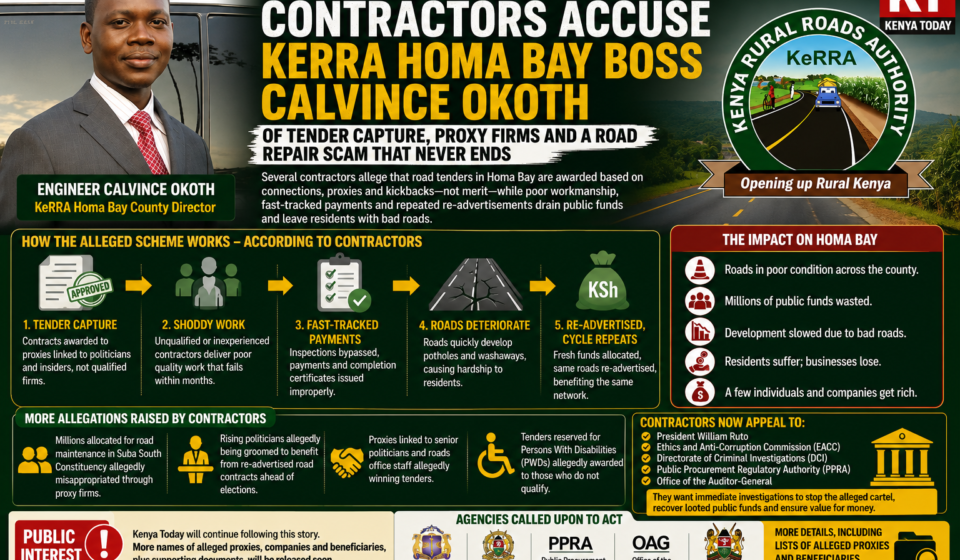
Inside Homa Bay’s Road Tender Storm: Contractors Accuse KeRRA Boss Calvince Okoth of Presiding Over a Broken Procurement System

Last Updated on July 1, 2026 by Joao Pedro
A storm is brewing at the Kenya Rural Roads Authority (KeRRA) offices in Homa Bay after a group of contractors accused senior officials including Kerra Boss Calvince Okoth of presiding over what they describe as a deeply compromised procurement system that rewards political connections over competence, leaving taxpayers to foot the bill for roads that barely last.
The contractors, who spoke on condition of anonymity for fear of victimization, claim the county’s road projects have become a lucrative enterprise for a well-connected network of proxies, politically connected individuals and insiders who allegedly manipulate tenders while genuine contractors are locked out.
According to the contractors, securing a KeRRA contract in Homa Bay is no longer about technical capacity, experience or offering value for money. Instead, they allege that success depends on “who you know” and whether one is willing to play by an entrenched system that they say has flourished for years.
SEE ANOTHER SCANDAL HERE
At the centre of the allegations are the county’s procurement office and senior KeRRA management. The contractors claim officials are fully aware that some contracts are allegedly awarded to proxy companies linked to influential individuals, including associates of a prominent politician from the Nyanza region.
The contractors further allege that professionally qualified firms, including companies owned by experienced civil engineers, are repeatedly overlooked while contracts are allegedly handed to individuals with little or no capacity to execute road works.
The consequences, they say, are visible across Homa Bay County.
The consequences, the contractors say, are visible across Homa Bay County. Roads that consume millions of shillings in public funds allegedly begin deteriorating only months after completion, forcing residents to endure poor transport networks despite repeated government spending.
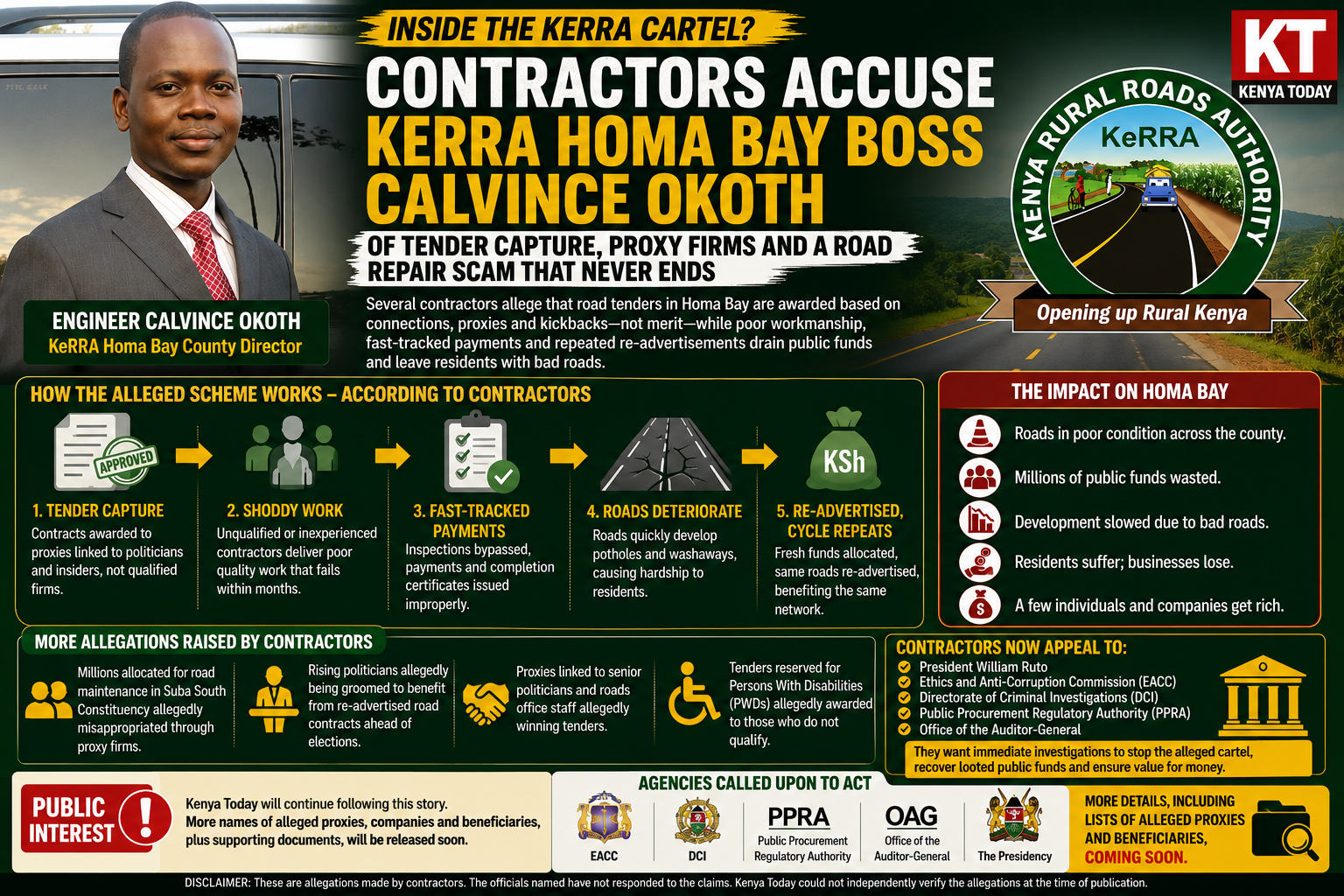
According to the contractors, the pattern rarely changes. Once the roads deteriorate, fresh funds are allocated, the same projects are advertised again and another round of contracts is awarded. They argue that instead of delivering durable infrastructure, the cycle has become a recurring business model that benefits a few well-connected individuals while taxpayers continue paying for the same roads over and over again.
According to the contractors, the beneficiaries are not the residents struggling with impassable roads but those allegedly feeding off repeated maintenance contracts.
They claim inspection processes have become little more than a formality, alleging that some contractors receive completion certificates and payments despite delivering work that fails to meet the required engineering standards.
If true, the allegations would raise serious questions about the effectiveness of quality assurance mechanisms within the authority and whether public funds are delivering value to taxpayers.
The contractors point to several roads in Gwasi as examples of projects that allegedly consumed public money yet remain in poor condition, forcing the government to allocate additional funds for fresh procurement.
They question how roads can repeatedly fail within such short periods without accountability for either the contractors or supervising officers.
One contractor described the situation as “manufactured failure.”
“The roads are built to fail so they can be repaired again. The people benefiting are not the wananchi but the same network that keeps winning the contracts,” the contractor alleged.
The whistleblowers further claim that some upcoming politicians are being positioned to benefit from future road tenders through proxy companies, allegedly with the backing of influential political figures seeking to build financial war chests ahead of future elections.
The allegations also extend to road maintenance funds allocated to Suba South Constituency.
The contractors claim millions of shillings meant to improve rural roads were instead channelled to companies allegedly linked to proxies of senior politicians and individuals connected to the roads office.
Another concern raised is the alleged abuse of procurement opportunities reserved for persons with disabilities.
According to the contractors, some tenders designated for PWD-owned enterprises are allegedly being awarded to individuals who do not qualify, denying vulnerable groups the opportunities created under public procurement laws.
If verified, such practices would undermine the objectives of the Public Procurement and Asset Disposal Act, which seeks to promote fairness, transparency and equitable access to government contracts.
The contractors are now calling on the Ethics and Anti-Corruption Commission, the Directorate of Criminal Investigations, the Public Procurement Regulatory Authority and the Office of the Auditor-General to investigate the procurement of road contracts in Homa Bay.
They are also appealing to President William Ruto to intervene, arguing that continued failure to address the alleged procurement irregularities is costing taxpayers millions while slowing development across the county.
The officials named in the contractors’ complaints had not responded to the claims by the time this story was prepared.
The contractors say they are compiling additional documents, including procurement records, company registrations and details they believe will help investigators determine whether politically connected proxy firms have benefited from public road contracts in Homa Bay.
Should such evidence emerge, it could trigger one of the most significant procurement investigations into rural road projects in the county in recent years.