
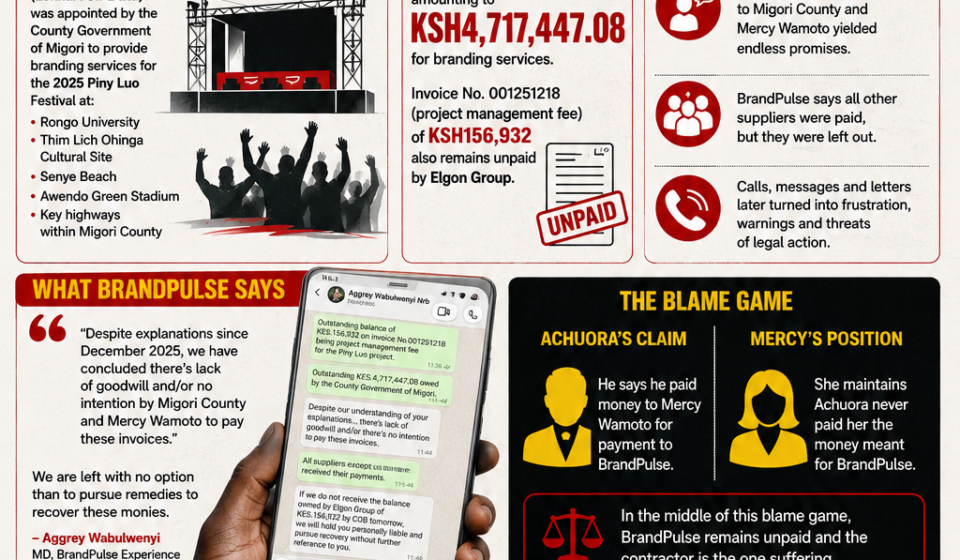
COURT BATTLE LOOMS AS BRANDPULSE DEMANDS KSH4.7 MILLION OVER UNPAID PINY LUO FESTIVAL DEAL, PUTTING MIGORI OFFICIALS AND ELGON GROUP ON THE SPOT

Last Updated on June 23, 2026 by Joao Pedro
The music ended months ago.
The politicians took their photos, gave their speeches and moved on.
The Piny Luo Festival banners came down, the stages were dismantled and the county got the publicity it wanted.
But behind the scenes, one of the companies that helped brand the event says it has been left stranded, unpaid and pushed into a humiliating chase for money that should have been settled long ago.
At the centre of the mess is Migori County Chief Officer for Finance Dr John Achuora, a man who now finds himself squarely on the spot over an unpaid KSh3,814,380.76 linked to branding and experiential services delivered during the 2025 Piny Luo Festival.
Also under scrutiny is Elgon Group CEO Mercy Wamoto, whose company’s name appears in the payment trail and correspondence surrounding the dispute. But if there is one public office that cannot run away from this scandal, it is the finance office at Migori County. That is where the real accountability sits. That is where the questions now point. And that is where the silence is becoming louder by the day.
This is no longer just a late invoice. It is a story about how county-backed events are used to burn public image into the sky while the people who did the work are left begging for payment long after the applause has faded.
THE BILL THAT REFUSED TO GO AWAY
A final demand notice dated April 1, 2026 lays out the heart of the dispute. In the letter, Lokhart SIPE Ltd trading as BrandPulse Experience demanded settlement of an outstanding amount arising from branding and experiential services rendered during the Piny Luo Festival 2025.
The letter was not written to some junior clerk in the county offices. It was addressed directly to Dr John Achuora, the Chief Officer for Finance in Migori County. That detail matters because it tells you exactly where the contractor believes the responsibility lies.
According to the demand letter, the company had already made a concession in an effort to resolve the matter quietly. It says it agreed, after prior engagements, to a discounted settlement amount of KSh3,814,380.76 from an original invoice of KSh4,717,447.08. Even after reducing the claim by almost a million shillings, the company says the amount still remained unpaid and had become “unacceptably overdue” since December 2025.
That single detail destroys any attempt to paint this as a stubborn supplier refusing to negotiate. The contractor had already blinked. It had already reduced the bill. It had already chosen compromise over confrontation. Yet months later, it was still writing final demand letters because the county had not paid.
That is where the scandal begins.
HOW DO YOU FAIL TO PAY EVEN AFTER A DISCOUNT?
This is the question Migori County should be answering, not avoiding.
How do you allow a supplier to finish work for a county-backed festival, wait for months, then accept a discounted figure, and still fail to settle the reduced amount?
That is not a small administrative oversight. That is not a harmless delay in paperwork. That is the kind of conduct that wrecks businesses, traps suppliers in debt and tells every serious contractor in Kenya that if you work with certain county projects, you might deliver the service, watch the event trend online and still go home empty-handed.
The contractor’s letter gave the county a final window to resolve the issue. It warned that unless the KSh3,814,380.76 was settled within seven days, the company would proceed with legal and administrative action to recover the debt, together with costs and interest. The letter copied the Governor of Migori County, the County Secretary, the CECM for Finance and Elgon Group Ltd.
That is not how a routine invoice is handled. That is how a supplier behaves when it has concluded that soft follow-ups, phone calls and patience are no longer working.
ACHUORA IS NOW AT THE CENTRE OF THIS MESS
The temptation in stories like this is always to spread blame so widely that no one is really held to account. That should not happen here.
Yes, Elgon Group’s name appears in the correspondence. Yes, Mercy Wamoto has been drawn into the dispute. Yes, there are whispers about who was supposed to pay who and whether money was passed along the chain.
But the one office that cannot hide in that fog is the office of Dr John Achuora.
He is not a bystander. He is not a spectator. He is the Chief Officer for Finance. If a county-linked claim of this size remains unpaid, his office is where the answers should come from.
Did Migori County approve the branding bill? Did it process payment? Did it release money to anyone? Did it hold the money back? Did it expect another party to settle the debt? Was there a formal payment arrangement involving Elgon Group? Was the contractor informed of it? Was there a dispute over the amount? If so, why was a discounted settlement agreed and still not honoured?
These are not difficult questions. They are the most basic questions any finance office should answer in a matter involving millions of shillings and a formal final demand notice.
And yet, the contractor still appears to be chasing the money months later.
That is why Achuora now sits at the centre of this scandal. The county finance office is the place where the paper trail either exists or falls apart. If the money was paid, let the records be produced. If it was not paid, let the county explain why. If someone else was tasked with settling it, let the county explain under what authority that happened.
What cannot continue is this theatre where a county officer occupies a public finance docket, a contractor says it is unpaid, a final demand is issued, and nobody wants to give a straight answer.
THE SMALLER BALANCE WAS PAID. THE BIG ONE WAS NOT
One important detail must be separated from the noise. A smaller amount of KSh156,932 that had also featured in earlier conversations around the project was paid. That is no longer the dispute.
The live dispute is the KSh3,814,380.76 settlement amount in the final demand letter.
That matters because it clears away the confusion and leaves the real issue standing in full view. The contractor is not fighting over scattered petty balances. It is demanding payment of a multimillion-shilling branding claim tied to one of Migori County’s most visible cultural events.
The county therefore has no excuse to muddy the story by mixing settled side amounts with the main outstanding debt. The core question is simple: why has the KSh3.8 million not been paid?
ELGON GROUP’S NAME KEEPS APPEARING. WHY?
Elgon Group’s CEO Mercy Wamoto cannot pretend her name is floating around this matter for no reason. The final demand letter copied Elgon Group Ltd. Earlier WhatsApp follow-ups and correspondence also placed Mercy close to the dispute. That is why questions now hang over the company’s role in the Piny Luo payment structure.
Was Elgon Group merely an event-linked player copied for information? Was it involved in project coordination? Did it have a role in supplier management? Was it expected to process or facilitate any part of the payment chain? If the answer to all those questions is no, then that should be stated clearly and publicly. If the answer is yes, then the public deserves to know the exact nature of that role.
But even here, the county must not try to hide behind Elgon Group. The final demand was directed to Migori County’s Chief Officer for Finance. That tells you where the supplier believes the payment obligation sits.
Mercy Wamoto may have questions to answer. But the heaviest public burden remains on Migori County and its finance office.
THIS IS HOW COUNTIES KILL SMALL AND MID-SIZED BUSINESSES
There is a reason stories like this keep repeating themselves across Kenya.
County governments and public entities love suppliers when there is an event to be branded, a conference to be staged, a campaign to be launched or a public relations mess to be cleaned up. At that stage, everything is urgent. Deadlines are tight. Visibility matters. The county wants banners up, stages branded, media walls mounted, highways dressed and venues looking polished before the governor arrives.
Suppliers are pushed to move quickly. They commit staff, printers, designers, fabricators, transport, logistics teams and installers. They spend money upfront because public events do not wait for payment cycles.
Then the event ends.
The leaders move on.
The hashtags die.
And the supplier is left with invoices, calls, promises and silence.
That is the ugliest part of this story. Public events are often built on private cash flow. The supplier takes the financial risk, does the work, makes the county look good, and then spends months chasing the same public officials who were desperate for the work to be finished on time.
Migori County now stands accused of doing exactly that.
A FINAL DEMAND NOTICE IS NOT A LOVE LETTER
By the time a company writes a final demand notice, the relationship is already damaged.
It means the soft reminders have failed. It means the phone calls have failed. It means the polite follow-ups have failed. It means the supplier now believes that without legal pressure, the debt may never be settled.
That is where Migori County allowed this matter to go.
The contractor says it completed the branding and experiential work for Piny Luo Festival 2025. It says it reduced the claim. It says it still was not paid. It then wrote to the county finance boss warning that legal and administrative action would follow if the amount was not settled within seven days.
That is not just embarrassing for the county. It is a public indictment of how it handles people who do business with it.
If the county had a valid reason for withholding the money, it should have put that reason on record. If it believed the amount was disputed, it should have resolved that dispute formally. If it had already paid someone else in the chain, it should have produced the evidence and informed the supplier. What it should not have done is leave the matter to rot until a final demand notice was sitting on the desk of the chief finance officer.
THE COUNTY MUST NOW ANSWER VERY SIMPLE QUESTIONS
Migori County owes the public, and the contractor, direct answers.
Was BrandPulse engaged to provide branding and experiential services for the Piny Luo Festival 2025? If yes, did the county receive the services? Did the county approve the original invoice? Why was a discounted settlement of KSh3,814,380.76 agreed? Who approved that settlement? And why, after agreeing to it, did the county still fail to pay?
Did Dr John Achuora’s office process any payment linked to that claim? If yes, to whom was it paid, on what date and under what authority? If no payment was made, why not? If another party was expected to handle settlement, what legal arrangement governed that process?
What role did Elgon Group play in the payment trail? Why was the company copied in the final demand notice? Was it merely being informed, or was it part of the chain through which the county expected this debt to be resolved?
Those are the questions that now matter. Not spin. Not silence. Not stories whispered in corridors. Hard answers backed by documents.
WHAT THIS DOES TO MIGORI COUNTY’S NAME
County governments do not exist in a vacuum. Suppliers talk. Event firms talk. Branding agencies talk. Contractors compare notes. Once a county becomes known for delayed payments, future work becomes more expensive, harder to source and more difficult to execute.
Why? Because suppliers start pricing in risk. They assume they may have to wait months. They assume they may need to chase. They assume they may need lawyers to recover money. The county ends up paying for its own bad reputation through higher future costs, weaker supplier confidence and constant suspicion.
That is what makes this scandal bigger than one unpaid invoice. It cuts into Migori County’s credibility. It sends a signal that a contractor can help make one of the county’s flagship cultural events look polished and still end up issuing a final demand notice months later.
No serious county should want that reputation.
THIS IS NOW A TEST OF WHETHER ACHUORA CAN ACCOUNT FOR THE MONEY
For Dr John Achuora, this is no longer just a supplier complaint sitting in an office tray. It is a public test of whether he can account for a disputed multimillion-shilling county-linked payment.
If he paid, he should say so and show the records.
If he did not pay, he should explain why.
If the county expected someone else to settle the debt, he should explain the basis of that arrangement.
If the amount was under review, he should explain why a discounted settlement was reached and then apparently ignored.
If none of that can be explained clearly, then the public is left with the most damaging conclusion of all: that a county finance office was either too careless, too disorganised or too indifferent to settle a legitimate supplier claim tied to a public event it was happy to celebrate.
That is not a small failure. That is a warning sign.
PAY THE COMPANY OR EXPLAIN THE DELAY
Migori County cannot keep playing hide and seek with a supplier’s money.
The cleanest way out of this scandal is simple. If the KSh3,814,380.76 is genuinely owed, pay it and close the matter. If there is a legal or factual dispute, place it on record and stop hiding behind silence. If another party handled the funds, say so and produce the evidence.
But what the county cannot keep doing is letting a contractor carry the cost of a public festival while county officials and event-linked players dodge responsibility.
The Piny Luo Festival gave Migori County visibility, headlines and public attention. It should not also become a symbol of how suppliers are used, drained and discarded once the event lights go off.
Right now, the county has a choice. It can clean up this mess by paying what is owed or explaining, with documents, why the money has not been released.
Or it can keep quiet and let the story harden into what it already looks like from the outside: a county-backed festival payment scandal with Dr John Achuora sitting right at the centre of it.