

EABL’s Second PR Spin on the Asahi Deal Exposes a Corporate Giant Desperate to Silence Scrutiny

Last Updated on June 23, 2026 by Joao Pedro
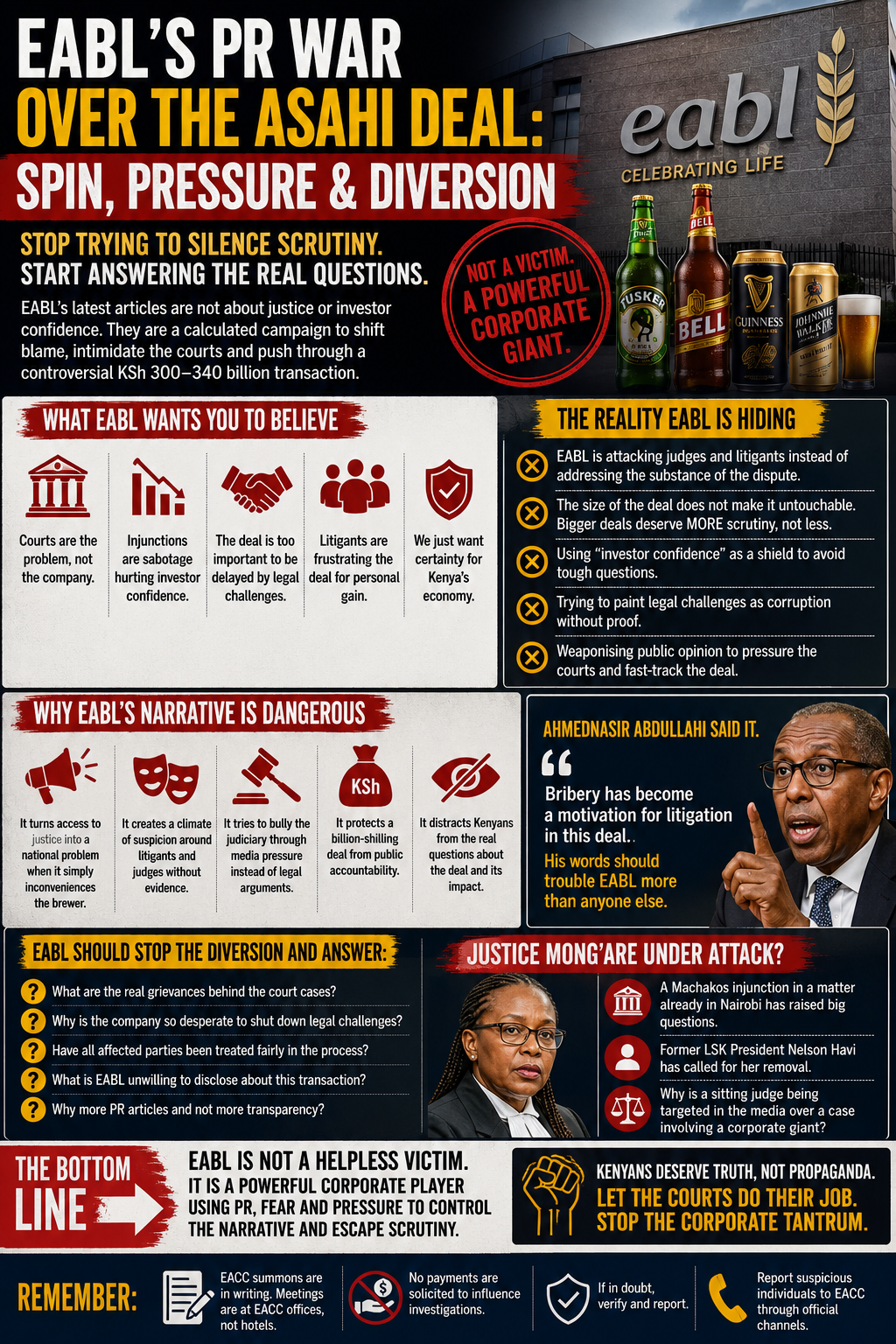
The second article now being circulated in defence of East African Breweries Plc (EABL) over the controversial Asahi transaction confirms what was already becoming obvious: the brewer is no longer merely fighting a legal battle in court. It is now fighting a full-blown public relations war designed to recast itself as the victim, demonise the judiciary and delegitimise anyone standing in the way of a multi-billion-shilling deal.
This is no longer subtle.
The latest draft sent out in support of EABL does not even try to hide its mission. It is carefully packaged to look like a sober discussion about commercial certainty, investor confidence and the dangers of endless litigation. But underneath that polished language is a very simple corporate message: EABL wants the public to stop asking what is wrong with the deal and start blaming the courts for slowing it down.
That is the con.
Instead of addressing the substance of the dispute around the EABL–Asahi transaction, the article tries to turn the spotlight onto the legal system itself. It says the repeated court challenges are raising questions about Kenya’s ability to handle high-value commercial transactions. It leans heavily on Ahmednasir Abdullahi’s remarks about bribery and delay. It revisits the criticism of Justice Josephine Mong’are and the Machakos injunction. It laments uncertainty. It warns about investor fear. It wraps the whole thing in the language of national economic concern.
What it does not do is ask the most important question of all:
Why is EABL so desperate to make this case about everyone else except EABL?
That omission is the real story.
Because once a company starts pumping out article after article framing itself as the casualty of the legal system, the public has every right to ask what exactly it is trying to avoid discussing. EABL is one of the most powerful corporate entities in East Africa. It has the resources, lawyers, boardroom influence and media access to shape public narratives far more effectively than any small litigant opposing the deal. So when such a company begins circulating “thought pieces” about judicial uncertainty and economic disruption, that is not innocent commentary. That is a strategic attempt to seize control of the story.
And the story EABL wants told is very clear.
It wants Kenyans to believe that the real scandal here is not the transaction itself, not the grievances behind the litigation, not the rights of the parties challenging the deal, and not the conduct of a giant brewer moving billions. No. According to EABL’s preferred script, the real scandal is that the courts are slowing things down and making investors nervous.
That framing is as cynical as it is revealing.
It tells you exactly how EABL sees this battle. Not as a dispute in which all sides deserve a hearing, but as an annoying obstacle to a transaction the brewer has already decided should be beyond interruption. The company’s outrage is not really about legal principle. It is about delay. It is about inconvenience. It is about the irritation of having to defend a major transaction in public rather than glide through it behind the protective language of “investment” and “market confidence.”
That is why this second article is so important.
It exposes the corporate mindset behind the campaign.
The first trick in the article is the way it elevates the EABL–Asahi deal into a kind of sacred economic event whose interruption is automatically harmful to Kenya. The transaction is described as one of the largest corporate deals in the country’s history. The piece stresses its importance to the market. It suggests that because the deal is big, every injunction and court challenge sends the wrong signal to investors. It effectively argues that Kenya cannot afford this kind of uncertainty.
That sounds persuasive until you stop and think about what it really means.
EABL is trying to use the size of the transaction as a weapon against scrutiny.
The company wants the public to conclude that because the deal is worth billions, it should not be slowed down by ordinary litigation. Because it involves foreign investors, it should be protected from disruption. Because it is commercially significant, the courts should somehow clear the runway and allow it to land.
That is not how justice works.
A billion-shilling transaction does not become untouchable because it is large. If anything, the bigger the deal, the more careful the public should be. The more money involved, the more legitimate it becomes to ask who benefits, who loses, what rights may be trampled and whether powerful corporate actors are trying to bulldoze their way through unresolved disputes.
But EABL’s article wants the opposite.
It wants scale to replace scrutiny.
It wants value to replace accountability.
It wants the market price of the transaction to do the moral work that EABL itself should be doing through transparent answers.
That is why the piece keeps leaning on “commercial certainty.” It is not a neutral phrase here. It is being used as a shield. It is corporate code for this: stop interfering with our deal. It is the polite boardroom version of impatience. The brewer is essentially telling the country that access to justice is fine in theory, but not if it gets in the way of a transaction involving Diageo, Asahi and one of the biggest listed companies in the region.
That is where the arrogance begins to show.
Because nowhere in the article does EABL seriously confront the possibility that some of the people challenging the transaction may actually have genuine grievances. Nowhere does it examine whether the legal challenges arise from unresolved commercial wrongs, historical disputes or legitimate claims that deserve a hearing before the deal is finalised. Instead, the article repeatedly nudges the reader toward a very different conclusion: that prolonged litigation itself is suspicious, that repeated challenges are inherently abusive, and that the legal process is being used as a strategy to frustrate the transaction.
In other words, EABL wants every obstacle recast as bad faith.
That is incredibly convenient for the brewer.
Once you paint litigation as obstruction, you no longer have to answer the underlying claims. Once you frame court challenges as sabotage, you no longer have to engage seriously with the people bringing them. Once you turn judicial scrutiny into an economic threat, you can pressure the public into seeing legal rights as a nuisance.
That is what this article is doing.
It is not defending law.
It is defending momentum.
And there is a big difference between the two.
The second trick in the article is the way it borrows Ahmednasir Abdullahi’s bribery remarks to create an atmosphere of moral panic around the case. The piece says Ahmednasir’s comments about the EABL–Asahi deal being frustrated unless a bribe is paid have triggered a wider debate about commercial litigation in Kenya. It says such concerns should trouble anyone interested in the investment climate. It implies that the deal has become trapped in a judicial environment where delay may itself be a strategy.
That is a clever move, but also a deeply dishonest one.
Because by centering Ahmednasir’s remarks, the article is able to plant the idea of bribery, extortion and bad-faith litigation around the dispute without ever having to prove that the parties challenging EABL are actually doing any of those things. It is a form of narrative contamination. You flood the story with the language of corruption and investor fear, and soon the public stops seeing the legal dispute on its own terms. Instead, it starts seeing every injunction as potentially dirty and every challenge as possibly part of a larger shakedown.
That is a gift to EABL.
It lets the company benefit from the suspicion without carrying the burden of proving it.
It lets the brewer say, in effect, “Look at this broken system, look at these endless cases, look at what senior lawyers are saying,” while quietly avoiding the much harder task of explaining why its transaction has attracted this much hostility in the first place.
And that is the pattern now impossible to ignore.
Every article EABL pushes seems designed to move the centre of gravity away from the company and toward the system. The problem is never EABL. The problem is always the courts. Or the litigants. Or the injunctions. Or the uncertainty. Or the investment climate. Or Justice Mong’are. Or “forum shopping.” Or Kenya’s image abroad.
Everyone is guilty except the brewer.
That is why the piece reads less like analysis and more like a corporate escape route.
The article’s treatment of Justice Josephine Mong’are is especially telling. It revives the criticism around her Machakos injunction and notes that she has become a subject of debate among lawyers, with Nelson Havi among those calling for scrutiny. It then states, almost casually, that in the EABL–Asahi case she “pulled a shocker” by issuing an injunction in Machakos for a matter being adjudicated in Nairobi, “giving all the signs of vested interests.”
That line is extraordinary.
A corporate-friendly article is openly implying that a sitting judge’s conduct carries the signs of vested interests in the middle of a live dispute, yet it does so without the discipline, caution or balance such a grave insinuation should require. That is not just commentary. It is pressure. It is part of a broader effort to delegitimise any judicial intervention that inconveniences EABL.
The brewer may not have written those words itself, but the article’s purpose is clear: build public hostility around the judge, build public impatience with the litigation, and create an atmosphere in which any further delay looks like evidence of corruption rather than an exercise of legal process.
That is dangerous territory.
A company of EABL’s size should be extremely careful about appearing to use media narratives to corner the judiciary. Once a corporate giant starts circulating pieces that frame a judge as a suspicious obstacle to a transaction, it stops looking like a party defending its legal rights and starts looking like a powerful institution trying to bully the process through public pressure.
That is the risk EABL is now running.
And it is making the brewer look worse, not better.
Because the more EABL leans into these articles, the more it begins to resemble a company that cannot tolerate scrutiny. The more it invokes investor confidence, the more it sounds like a boardroom bully demanding a clear path. The more it complains about “endless uncertainty,” the more the public is entitled to ask whether the brewer simply wants the courts to move at its preferred speed and on its preferred terms.
That is not a good look for a company trying to claim the moral high ground.
The deeper problem here is that EABL appears to believe that legal friction itself is illegitimate when it affects a deal of this size. That belief is all over the article. It is there in the tone. It is there in the frustration with recurring litigation. It is there in the attempt to transform access to justice into a national economic headache. It is there in the subtle demand that the country must somehow choose between hearing disputes and attracting investors, as if those two things are enemies.
They are not.
A functioning investment climate depends on the existence of courts willing to hear disputes, even inconvenient ones. Investors do not just want speed. Serious investors also want fairness, predictability and a legal system where grievances are not buried under corporate pressure. If EABL truly cared about Kenya’s long-term credibility, it would understand that point. It would know that the country’s reputation is not protected by shaming litigants or demonising judges every time a transaction hits turbulence.
Kenya’s reputation is protected when the courts are allowed to work without intimidation and when powerful companies answer legitimate claims with law rather than PR warfare.
That is what makes this second article so revealing.
It strips away the polite language and shows the brewer’s real frustration. EABL does not merely want to win the legal argument. It wants to control the atmosphere around the case. It wants the public primed to see delay as sabotage. It wants every injunction to look suspect. It wants every judge who slows the transaction to be treated as a problem. It wants every legal challenge weighed not against the merits of the case, but against the commercial importance of the deal.
That is not justice.
That is corporate entitlement.
And it is exactly why this article should be treated with suspicion.
The more EABL pushes these narratives, the clearer it becomes that the company is trying to transform a legal contest into a public campaign for immunity from scrutiny. It is trying to tell Kenyans that the real danger is not a powerful brewer facing court challenges over a massive transaction, but a judiciary bold enough to interfere with the brewer’s timetable.
That is absurd.
The real danger is a corporate culture that thinks “investment” should silence dissent.
The real danger is a public discourse in which billion-shilling companies try to rebrand judicial scrutiny as economic sabotage.
And the real danger is a media environment where boardroom interests are fed to the public as if they are neutral commentary about the national good.
That is why EABL deserves to be hit hard here.
Not because the company is wrong to defend itself in court.
Not because it has no right to argue that the transaction should proceed.
But because it is trying to do something much uglier than that.
It is trying to use fear of investor flight, frustration with the judiciary and innuendo about corruption to crush the legitimacy of any challenge to the Asahi deal.
That is not the conduct of a transparent corporate citizen.
It is the behaviour of a powerful institution trying to bend the conversation until the only acceptable outcome is the one it wants.
And that, more than any injunction, is what should worry Kenyans.